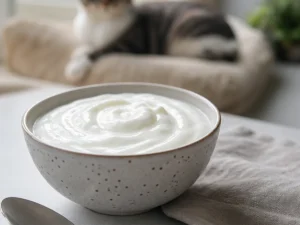
Can Cats Eat Yogurt? Plain, Greek, Flavored, and Probiotic Types
Some healthy adult cats can tolerate a teaspoon or less of plain, unsweetened yogurt, but many cannot digest dairy comfortably. Flavored cups require a full label check, and yogurt should never displace balanced cat food or be treated as a guaranteed probiotic treatment.
First, sort the yogurt by what is actually in the cup
The word yogurt covers everything from plain cultured milk to dessert with syrup, candy pieces, artificial sweetener, and granola in the lid. The answer for your cat begins with the ingredient panel, not the pastoral cow on the label.
| Yogurt type | Reasonable cat-owner answer | Details to check |
|---|---|---|
| Plain unsweetened dairy yogurt | At most a tiny trial for a healthy adult | Lactose, fat level, and individual tolerance still matter. |
| Plain Greek yogurt | Similar tiny-trial rule | Straining changes texture and nutrients but does not guarantee zero lactose. |
| Fruit-on-the-bottom yogurt | Usually skip | Added sugar, concentrates, seeds, sweeteners, or unsafe fruit pieces may appear. |
| Vanilla or flavored yogurt | Read closely and generally avoid | Sugar, extracts, cocoa, coffee, or additives change the product. |
| Sugar-free or keto yogurt | Do not serve without a complete review | Alternative sweeteners and very high fat formulations vary. |
| Plant-based yogurt | Not automatically suitable | Coconut, nuts, soy, oils, gums, and fortification require separate consideration. |
| Yogurt marketed for cats | Follow the package and veterinarian | Confirm it is a treat or a complete food and use the stated portion. |
Lactose tolerance is personal, not a feline badge
Milk sugar is broken down by the enzyme lactase. Many cats produce less lactase after weaning, so dairy that looks gentle to a person may lead to gas, bloating, loose stool, or vomiting in the litter-box owner.
Culturing can lower the lactose content compared with the starting milk, and bacterial cultures may digest some lactose. Neither fact guarantees that a particular cat will tolerate a particular brand, serving size, or recipe.
The ASPCA’s people-food safety list explains that milk products can cause diarrhea or digestive upset because pets do not possess significant lactase. This is an intolerance issue for many cats, not proof that every trace of yogurt is a poison.
A cat who handles one lick may still become uncomfortable after several spoonfuls. Portion size is part of tolerance, and a café-size dollop is enormous when translated to feline body weight.
If you choose a taste, make the test boring
Select pasteurized, plain, unsweetened yogurt with the shortest straightforward ingredient list you can find. Let the cat lick a small smear, roughly one-quarter teaspoon, rather than presenting an open container.
Wait a full day before considering it tolerated and watch appetite, energy, vomiting, gas, and stool quality. Even after a calm trial, there is little reason to exceed about one teaspoon on an occasional basis for an average healthy adult.
Those amounts are practical guardrails, not toxicology thresholds. A smaller cat, sensitive stomach, calorie restriction, or medical diet can justify skipping yogurt completely.
Take the portion from the cat’s treat budget instead of adding it invisibly to the normal intake. Cornell’s feeding guidance for cats says treats are not complete nutrition and should be offered only occasionally.
Greek yogurt is thicker, not automatically safer
Greek yogurt is strained, so its protein, moisture, fat, and carbohydrate profile can differ from conventional yogurt. Brands also vary considerably, especially when one is nonfat and another is made from whole milk with cream.
Straining may reduce lactose, but “Greek” is not the same as “lactose-free.” A cat with poor dairy tolerance can still develop digestive signs from a seemingly wholesome spoonful.
Our dedicated Greek yogurt guide for cats compares plain, flavored, low-fat, and strained products in greater detail. Use the actual carton because nutrition and ingredients beat assumptions about style.
Yogurt is not a dependable do-it-yourself probiotic
“Contains live cultures” tells you that organisms were used in fermentation; it does not establish that the product treats your cat’s diarrhea, constipation, allergies, or immune disease. Probiotic effects depend on the specific strain, dose, viability, storage, condition being treated, and evidence in the target species.
The culture names and counts in grocery yogurt may not match a veterinary product, and some cups do not guarantee a useful quantity through the end of shelf life. Added dairy, sugar, and calories can also work against the goal.
If a veterinarian recommends a probiotic, ask for the exact product, dose, duration, and storage instructions. Do not replace prescribed care with whichever yogurt happens to be behind the mustard.
Diarrhea that is severe, bloody, accompanied by vomiting or lethargy, or persistent needs veterinary assessment. Kittens and medically fragile cats can dehydrate quickly, so experiments belong later, if at all.
Fruit flavors bring multiple ingredient questions
Strawberry, blueberry, peach, mango, and mixed-berry yogurt usually contains more than fruit and cultured milk. Sugar, juice concentrate, starch, color, flavor, pectin, seeds, and sweeteners may all join the cup.
Fruit pieces can be slippery, and pits or hard fragments should never be present in a cat’s serving. Raisin-containing varieties, grape mixes, and unknown fruit medleys are poor choices because the feline evidence around grape risk remains limited and there is no reliable safe dose to use at home.
The site’s cat fruit overview helps identify peel, pit, seed, and preparation problems before they disappear into dairy. Plain yogurt is much easier to assess than a purple swirl with six ingredients hiding under the label fold.
Honey, granola, and crunchy toppers
Honey adds concentrated sugar without solving the lactose question. It also should not be given to very young or immunocompromised animals as an improvised wellness food.
Granola can include raisins, chocolate, nuts, seeds, coconut, salt, spices, and hard clusters that are awkward to chew. Yogurt lids with separate mix-ins deserve two ingredient checks, not one.
Our honey article explains sticky texture, sugar, vulnerable cats, and products that combine honey with other substances. Scraping off a topping does not reliably remove syrup or fine crumbs already mixed through the cup.
Chocolate, coffee, and dessert cups
Chocolate chips, cocoa, brownie crumbs, mocha flavor, and coffee concentrate can introduce methylxanthines. A small cat and a concentrated dark-cocoa product are not a combination to assess by guesswork.
Cookie dough, cheesecake, pudding-style yogurt, and frozen yogurt may add raw flour, rich fat, candy, alcohol flavoring, or large sugar loads. “Yogurt” on the sign does not make the dessert nutritionally equivalent to a plain cultured carton.
For any cocoa exposure, collect the brand, type, cocoa percentage, amount, and time, then use our chocolate guide for cats while contacting veterinary help. Do not delay a call until symptoms appear when the amount could be meaningful.
Sugar-free, high-protein, and supplement yogurts
Sugar-free formulas can contain alternative sweeteners, while high-protein products may use milk-protein concentrates or other additives. A front-of-package health claim aimed at humans does not answer whether the cup belongs in a cat.
Xylitol causes a well-documented dangerous syndrome in dogs, but equivalent feline sensitivity has not been established. Because cat evidence is sparse and mixed products bring additional hazards, call with the exact label rather than declaring a sugar-free exposure safe or certain to be toxic.
Products may also add caffeine, green-tea extract, vitamins, minerals, fiber concentrates, herbal ingredients, or protein powders. More supplementation is not automatically better for a cat already eating a formulated diet.
The FDA describes how complete pet foods earn their nutritional adequacy statement. Human yogurt, no matter how impressive its protein number, has not been designed to fill that role.

Plant-based yogurt moves the question rather than ending it
Coconut yogurt can be high in fat, almond yogurt introduces a nut ingredient, and soy or oat products use their own protein and carbohydrate systems. Gums, oils, sugar, flavoring, and fortification differ widely.
An uncomplicated lick may cause no harm, but dairy-free is not a feline safety certification. Check for chocolate, coffee, macadamia, cannabis, sweetener blends, and any ingredient your cat must avoid for allergy testing.
Never assume a human plant-based product can replace a complete cat food. Cats have species-specific nutrient requirements that do not disappear when a carton is marketed as high-protein or environmentally friendly.
Food safety does not stop after fermentation
Yogurt is perishable and should be kept cold according to its label. The FDA recommends keeping the refrigerator at 40°F or below and following the two-hour rule for foods that need refrigeration.
Discard a cup with mold, swelling, leaking, an odd odor, or questionable temperature history. Do not scoop around a mold patch and serve the apparently clean side to a pet.
Use a clean spoon and put the small cat portion in a separate dish. Repeated licking from the family carton adds contamination, and the deep container can trap a determined head.
Foil lids and little cups deserve attention
Peel-off foil holds fragrant residue and can slice the mouth when chewed. Plastic cups can crack into sharp pieces, while multipack cardboard and shrink wrap may become an exciting foreign-body project.
Rinse or enclose empty packaging before it reaches the trash, and check that the foil seal is accounted for. If a piece is missing, call based on the material, size, timing, and any swallowing or digestive signs.
Who needs a veterinarian-selected treat
Kittens, pregnant cats, seniors with frailty, and cats with diabetes, obesity, kidney disease, pancreatitis, inflammatory bowel disease, dairy allergy, or chronic diarrhea should not receive casual yogurt experiments. Prescription and elimination diets also leave no room for surprise ingredients.
A cat taking medication may have specific food restrictions, and a dairy spoon is not always an appropriate pill vehicle. Confirm whether the medicine can be crushed and whether it should be given with food.
If you want a creamy texture, a spoonful of the cat’s usual wet food is often the cleanest alternative. It is familiar, portionable, and already part of the nutritional plan.
What to do when the carton has been sampled
- Read the whole package. Include the base, fruit layer, mix-ins, sweeteners, and flavor name.
- Estimate the missing volume. Note whether the cat licked the lid or ate a substantial section.
- Find every piece of packaging. Look for foil, plastic rim fragments, spoons, and mix-in packets.
- Record health context. Tell the clinic about diabetes, dietary trials, allergies, medication, and digestive disease.
- Escalate when the facts call for it. Toxic additions, absent packaging, a large amount, or abnormal behavior merits professional advice.
After a tiny plain-yogurt taste, monitor for vomiting, diarrhea, gas, reduced appetite, itching, or discomfort. Seek urgent help for breathing trouble, facial swelling, collapse, tremors, severe weakness, repeated vomiting, or suspected foreign material.
Do not give medication, induce vomiting, or add another dairy product to settle the stomach unless the veterinary team specifically directs it. Clear information from the label is far more useful than a kitchen remedy.
Frequently asked questions
Can cats eat yogurt every day?
Daily yogurt adds unbalanced calories and may repeatedly provoke lactose-related signs. If a clinician wants a daily probiotic or food topper, ask for a feline-appropriate product and a measured plan.
Is plain yogurt better than flavored yogurt?
Yes, plain unsweetened yogurt removes many variables, but it still contains dairy and is not necessary. Tolerance should be tested with a minuscule amount in a healthy cat only.
Can yogurt cure my cat’s diarrhea?
No grocery yogurt can be assumed to treat diarrhea, and some will worsen it. Persistent or severe signs need a diagnosis, while any probiotic should be chosen by strain, dose, and evidence with veterinary guidance.
Can cats eat frozen yogurt?
Frozen yogurt is usually a sweet dessert and may contain chocolate, candy, fruit syrup, or alternative sweeteners. A hard frozen bite can also be awkward to chew, so it is better left off the cat menu.
Bottom line
A pinhead smear of plain unsweetened yogurt may sit well with one healthy adult and upset another. Keep the trial tiny, distrust complicated flavors, treat probiotic promises critically, secure the foil lid, and let nutritionally complete cat food remain the dependable choice.